About Bridge Rectifier Diode
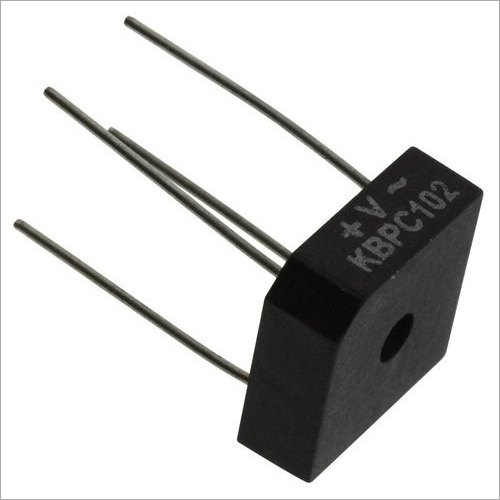
We are a renowned supplier of Bridge Rectifier Diode in the market. It provides full-wave rectification from a two-wire AC input, resulting in lower cost and weight as compared to a rectifier with a 3-wire input from a transformer with a center-tapped secondary winding. Bridge Rectifier Diode is also used in bridge topologies along with capacitors as voltage multipliers.
Voltage | 230 VAC |
Frequency | 50 Hz |
Phase | Single Phase |
Model Name/Number | KBJ410 |
Temperature | -0 to 175 Degree C |
Number Of Pins | 4 |
Packaging Type | Box |
The bridge rectifier diode simplifies AC to DC conversion for a variety of electronic applications. Its compact size makes it ideal for power supply circuits, providing a consistent and efficient DC output from an AC source. The four-diode configuration within the miniature package ensures instantaneous rectification with minimal power loss.
Reliable Performance in Tough ConditionsDesigned for durability, this bridge rectifier handles operating temperatures from -40C up to +125C. Its high isolation voltage and RoHS compliance assure safety and environmental responsibility, making it suitable for commercial and industrial electronic equipment, including those operating at frequencies of 50-60Hz.
Flexible Mounting & Versatile ApplicationsAvailable in both panel and PCB-mounted options, this bridge rectifier is easy to integrate into new or existing designs. The clearly marked polarity and straightforward 4-pin interface further streamline installation. Ideal for use in standard miniature applications, it meets the needs of diverse users and circuit requirements.
FAQ's of Bridge Rectifier Diode:
Q: How does a bridge rectifier diode convert AC to DC in electronic circuits?
A: A bridge rectifier diode uses four silicon diodes arranged in a bridge configuration to convert alternating current (AC) input into direct current (DC) output. When AC voltage is applied to its input pins, the diodes direct current flow so that both halves of the AC cycle are rectified, producing a pulsating DC suitable for powering electronic devices.
Q: What benefits does a silicon bridge rectifier offer over other rectifier types?
A: Silicon bridge rectifiers provide high efficiency, reliable thermal conductivity, and instantaneous response times. This allows for more stable DC output, lower power loss, and greater durability in challenging environments. Additionally, the compact design simplifies installation and saves valuable circuit board space.
Q: Where can this bridge rectifier diode be used?
A: This bridge rectifier is commonly used in power supply circuits, battery chargers, electronic equipment, and industrial control systems. Its versatility and high-rated voltage make it suitable for various applications requiring AC to DC conversion, particularly in settings where space and efficiency are priorities.
Q: What is the recommended mounting process for this rectifier diode?
A: The bridge rectifier can be either panel-mounted or directly mounted onto a PCB, depending on the application. Each pin is clearly marked for AC input and DC output to simplify correct installation. Secure mounting ensures proper thermal management and reliable long-term performance.
Q: When should I select a bridge rectifier with higher surge current capacity?
A: You should choose a model with a higher maximum surge current (Ifsm) when your application involves occasional high inrush currents, such as when switching on large transformers or capacitive loads. This ensures the rectifier can withstand these conditions without damage.
Q: What makes this bridge rectifier compliant with RoHS and suitable for commercial supply?
A: This diode meets RoHS standards, meaning it is free from hazardous substances like lead and mercury. Its compliance ensures it is safe for global markets and aligns with industry requirements for environmentally-friendly electronic components, making it a reliable choice for distributors and traders.
Q: How does the marked polarity on the device assist during installation?
A: The marked polarity on the bridge rectifier ensures correct wiring of the AC inputs and DC outputs, helping installers avoid reverse connections. This not only protects the device from potential damage but also guarantees accurate and safe circuit operation.





 Send Inquiry


 Send Inquiry
 Send Inquiry
 Send SMS